STUDY – 10 (beauty)
Ceramic stoneware
15h x 10w x 7d
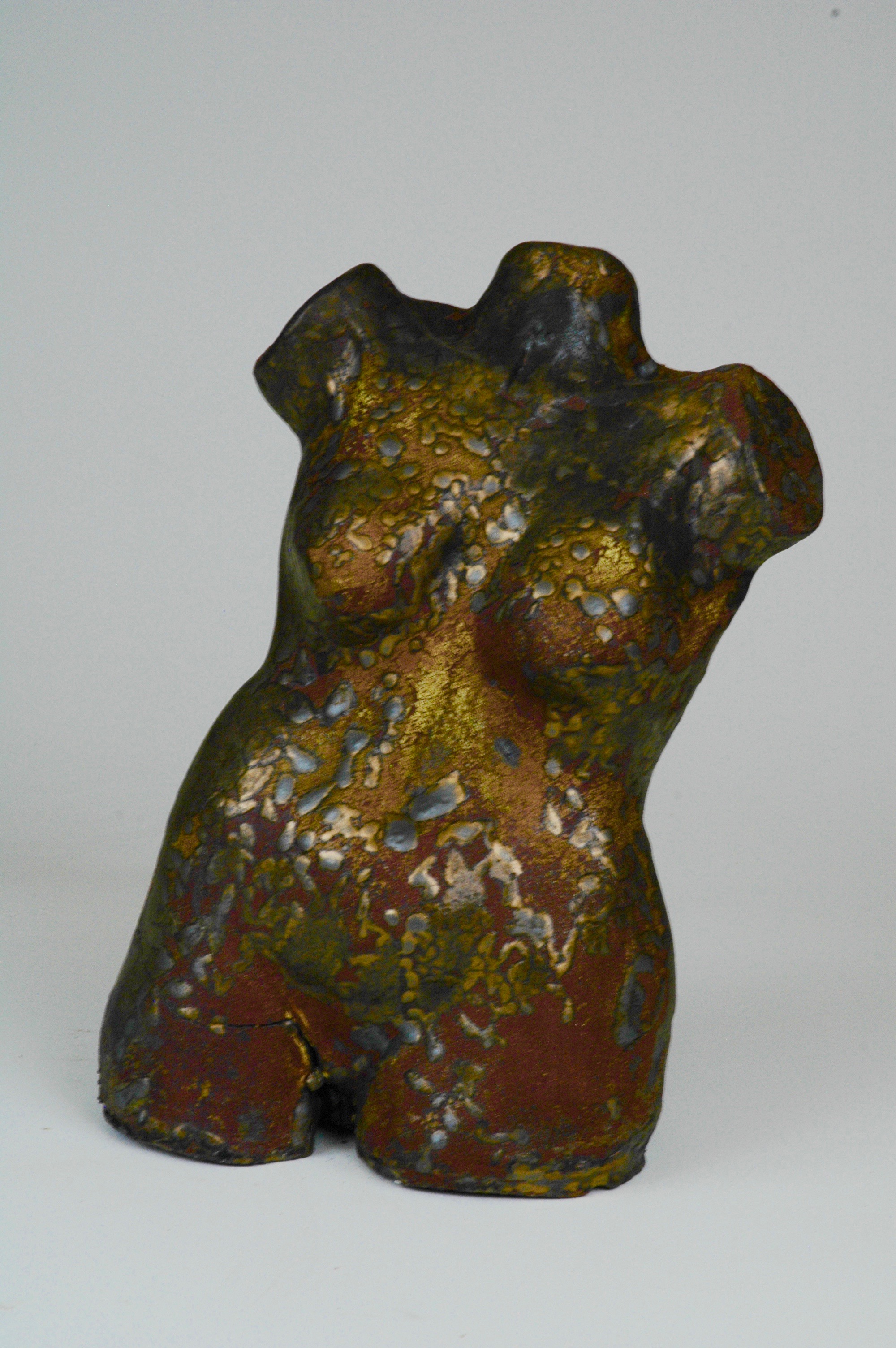
A female form with a striking bronze-like, golden, silvered, green tinged glaze.
STUDY – 10 (beauty)
Ceramic stoneware
15h x 10w x 7d
A female form with a striking bronze-like, golden, silvered, green tinged glaze.
LOSS
Ceramic, Steel Stand
22h x 12w x 13d
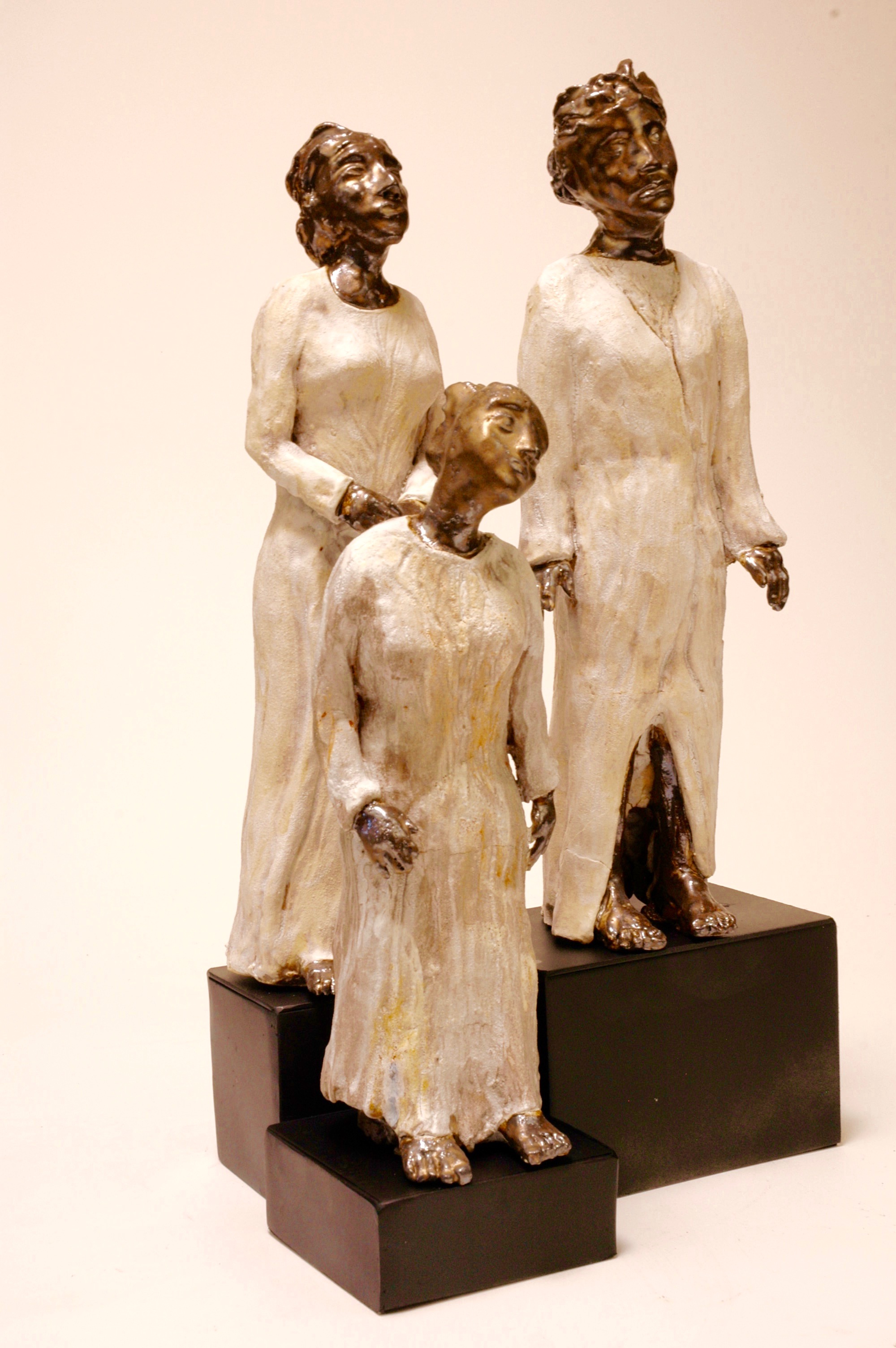
Yesterday the news media a reported the found body of a young woman, raped, burned and buried along a desolate trail in one of our parks. I cannot imagine the feelings of her mother and loved ones.
In face of death, particularly of loved ones, words are of little consequence. It is presence that is so important.
How better to express this experience than by the image of the women at the foot of the cross? They look look up at the man they loved. Their arms hang as if helpless.
My hope is that this piece is a comfort to someone who knows what it is like to experience the death of a loved one.

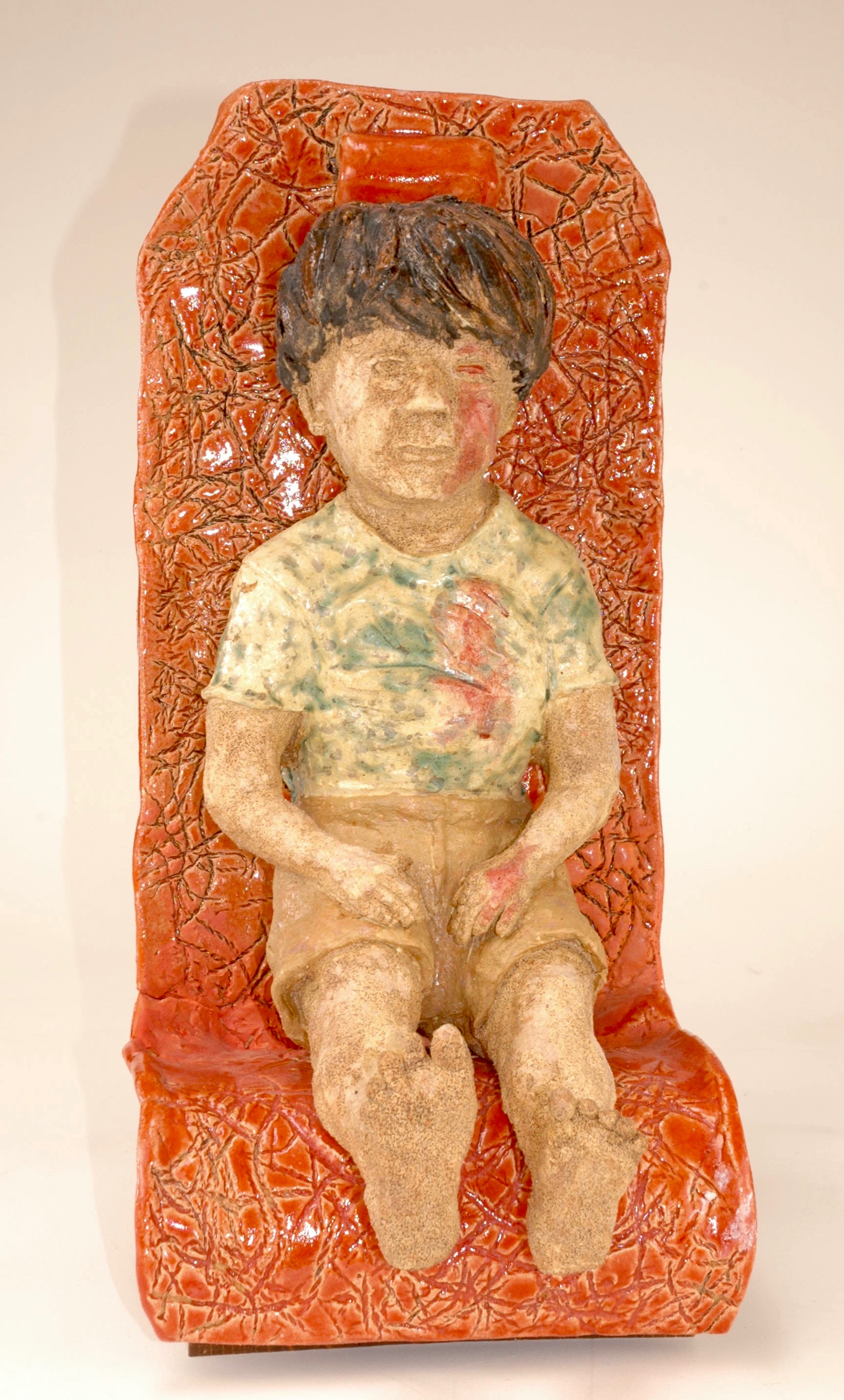
The photo of a dazed little boy from Aleppo sitting in an ambulance as a causality of war made front page news in 2016. His image is likened to the one from from the Viet Nam era when a photographer caught a naked young girl, burned and petrified, arms pleading, fleeing for her life. Who can forget that photo?
The image of the youngster from Aleppo is also difficult to forget. I have sculpted him as a way to express the loss of innocence. This boy has been introduced to war and its consequences.
18″ x 8″ x 9″
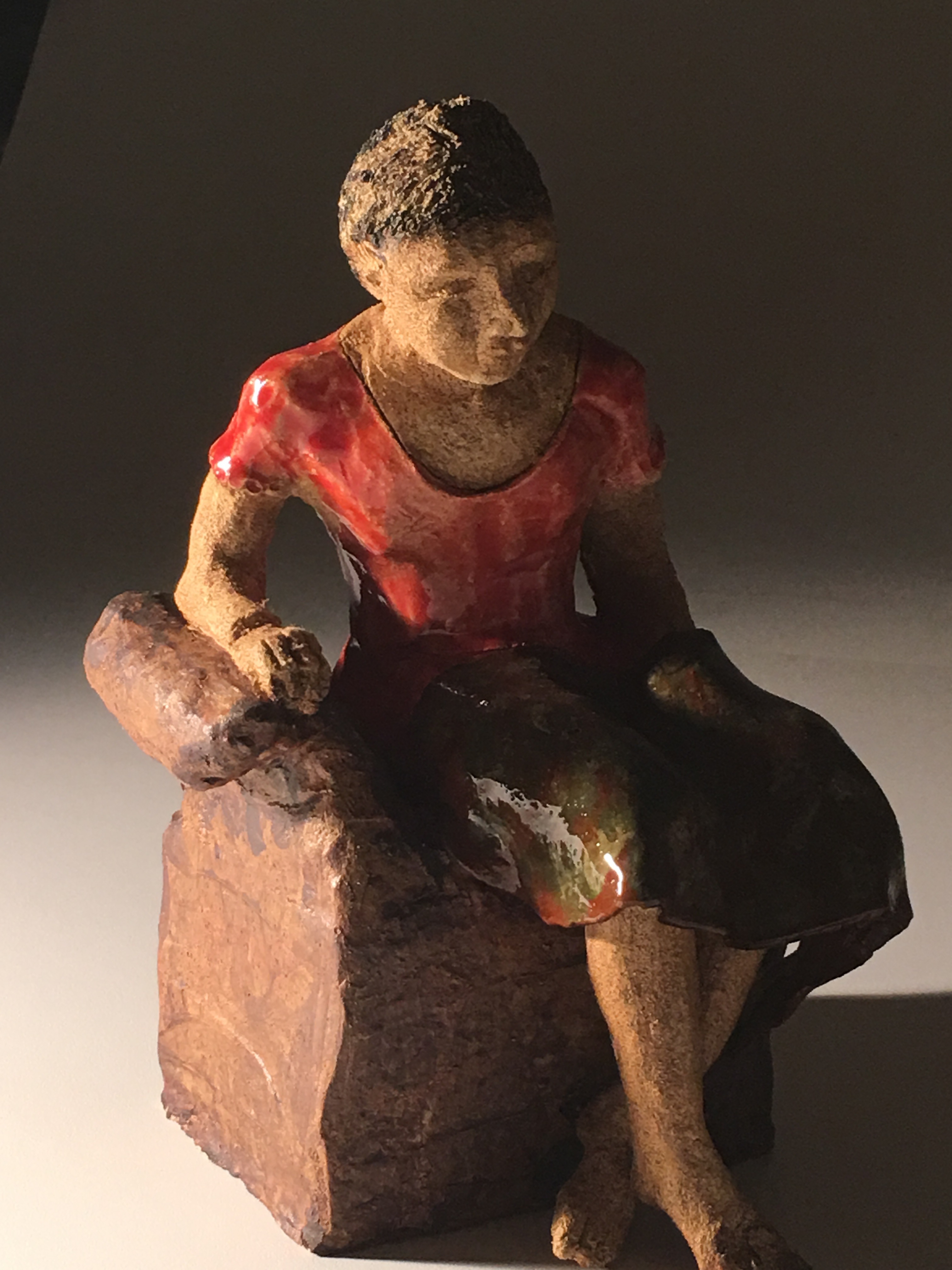
10″ x 8″ x 7″
The sculpture was occasioned by a chance request of a pregnant artist working across from me in a large shared studio. The room was quiet. I should say quiet until the young woman let out a shriek. She motioned to a woman working beside her. “Come over here. Feel the little guy kicking.” The woman went over and placed her hand on the woman’s belly. The pregnant woman seemed lost in reverie. Then she looked at me. “Come over here. Feel his foot,” I was hesitant. It seemed a little too intimate to do with someone I hardly knew.
However, touching her belly and seeing her lost in reverie got me thinking. There no other way that anyone enters into the world except through the body of the woman.
To quote John O’Donohue … A woman “is the portal to the universe. No two humans can ever come closer than when one is forming inside the other’s depths. No man ever comes nearer to a woman. No woman ever comes nearer to a woman. During the entire nine months the mother sees nothing. The whole journey is a hidden one. It is the longest human journey from the invisible to the visible. From every inner pathway, the labyrinth of her body brings a flow of life to form and free this inner pilgrim.”
The woman I’ve sculpted was occasioned by seeing Nicolas Africano’s untitled glass sculpture of a sitting woman.
12″ x 12″ x 8″
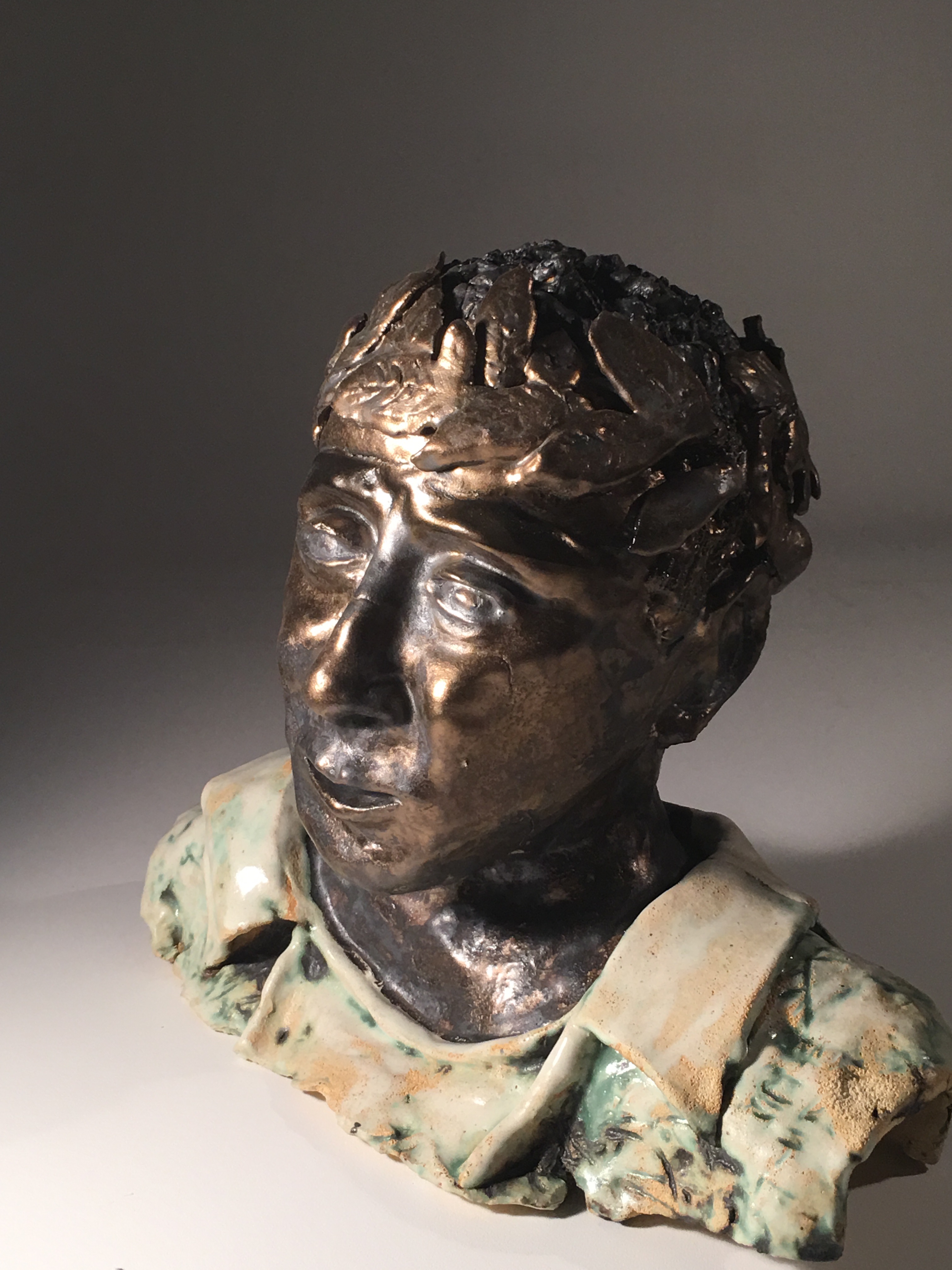
While antiquity has left us numerous busts of Marcus Aurelius, I wanted to sculpt another. Why? Because I admire the man. He had an inward life. This is how Professor Joseph Badaracco of the Harvard Business School described the emperor’s way of living.
“Marcus knew full well the areas and responsibilities of practical life. He ruled a vast, diverse, unruly empire that spanned much of Europe, North Africa, and the Middle East. Marcus was…the chief priest of the Roman religion, and the highest judge in the Roman courts…. How did Marcus Aurelius combine the life of action with the spirit of reflection? How did he take the long view of the urgent tasks of the present moment? The answers lie in his personal journal. During the last years of his life, Marcus kept an informal record of his reflections, observations, and self-criticisms. He wrote for himself, not for the eyes of others. He wanted to understand who he was and how he should work and live. Marcus called the journal “To Himself,” and only centuries later did it come to be called “Meditations.” (available free on Kindle, my note)
….
“The first lesson Marcus Aurelius might suggest for managers has nothing to do with work. In fact, its focus is on “not” working. Marcus’s advice would be to work hard to create moments of serenity. Again and again, throughout Meditations, Marcus reminds himself to slow down and step back, to withdraw and reflect. He writes, “Are you distracted by outward cares? Then allow yourself a space of quiet, wherein you can add to your knowledge of the Good and learn to curb your restlessness.” He tells himself, “Nowhere can a man find a quieter or more untroubled retreat than in his own soul.” And again, “Avail yourself often, then, of this retirement, and so continually renew yourself.”
…
“This talk of retirement and retreat may sound otherworldly and monkish. It may suggest someone without the stomach for the hard work of trying to make a practical difference in the world. But there is no indication that Marcus ever shirked the duties and cares of his position. He ruled until his death—and may actually have hastened it—because he refused, to the very end, to lay down any of the duties and burdens of his office.”
….
“Were Marcus Aurelius alive today, he might well ask managers whether they have, somewhere in their lives, a counterpart to his tent, with its candle and plain table. He would be inquiring (discreetly and quietly—for he was, by all accounts, a gentle soul) not about a physical location, but about a mental retreat where they could reflect and renew themselves. Marcus might well be astonished and concerned at how infrequently the men and women who shoulder so many of the world’s responsibilities remove themselves from other people, agendas, deadlines, telephones, and computers, and simply sit for a while and examine themselves, their lives, their thoughts and feelings.”
Joseph Badaracco, Defining Moments, pp 122, 123.
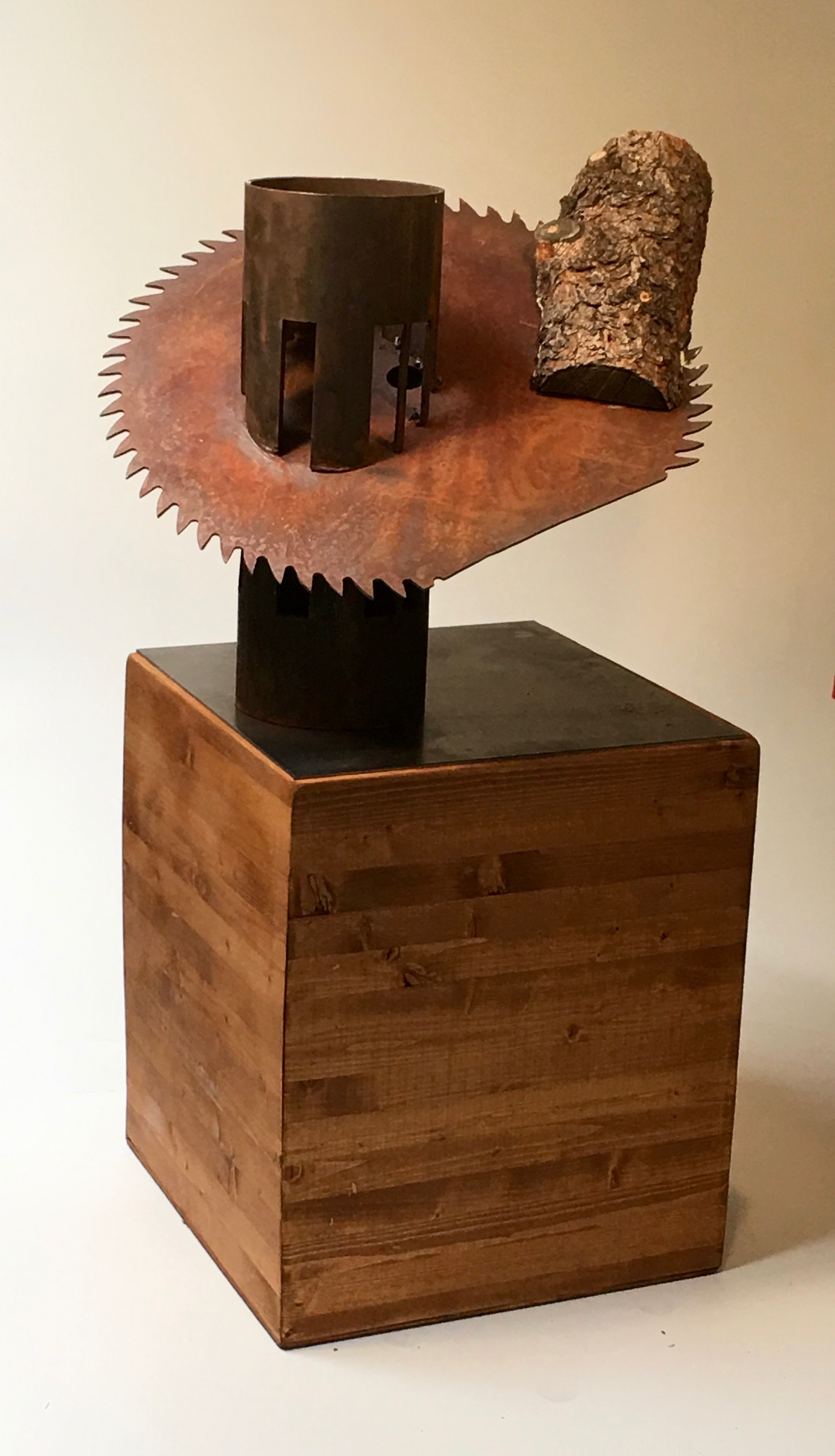
Joseph (steel) 18″ x18″ x 22″
Base (wood) 17″ x 17″ x 17″
Why would anyone name this contemporary sculpture “Joseph?” I reference the father of Jesus.
Statues of the sainted Joseph are frequently saccharine, often in plaster, sometimes plastic, and almost always of a Caucasian.
I have juxtaposed a saw blade, wood, and steel. My effort is to make a piece that is representative of the man, one that has its own beauty while representing a workman that has strength of character. Surely this image of the man is no less accurate, and hopefully more captivating, than a plastic statue.
The massive saw blade is discarded industrial waste. The wood was found among the fallen piñon trees in the hills surrounding Santa Fe. Together these seemingly unrelated discarded pieces make a statement…as does the life of the man named Joseph about whom we know little.
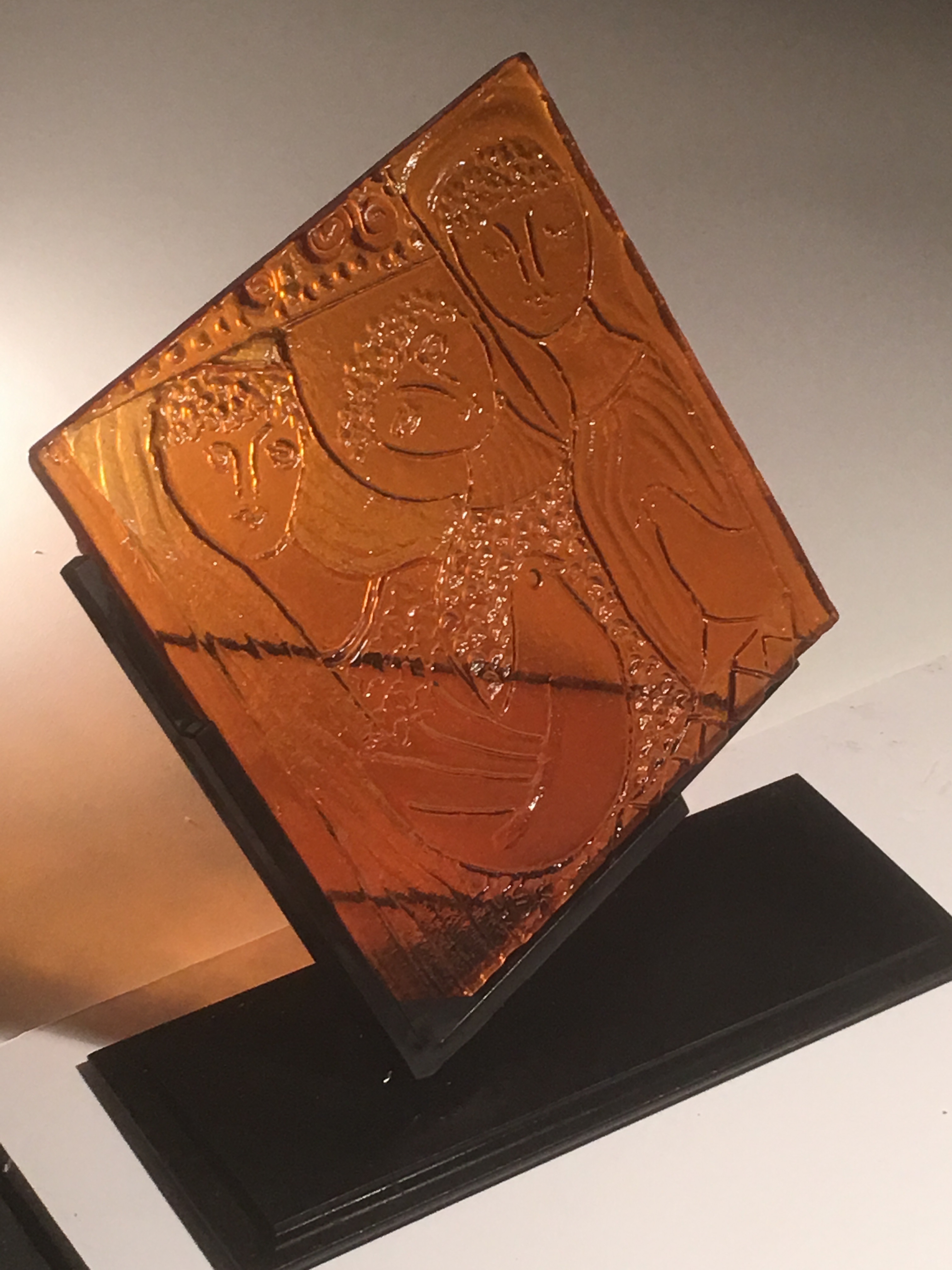
Glass, 10″ x 10″
Steel stand, 12″ x 5″
The work of Ruth Faktor, the highly accomplished Israeli ceramic artist, is the inspiration for this cast glass piece. When visiting a friend in New York I noticed she had one Ruth Factor’s ceramic panels among her cherished pieces. I loved it.
Back home I roughly sculpted Ruth Faktor’s piece in clay and then cast it in glass. Though her piece was not titled, it reminded me of the three graces found within Greek and Roman mythologies. I do not know if the artist had the three graces in mind yet every time I glance at this piece, I think of charm, beauty and creativity, the gifts of the three graces.
Check out some of Ruth Faktor’s work at http://www.sapergalleries.com/RuthFaktor.html.
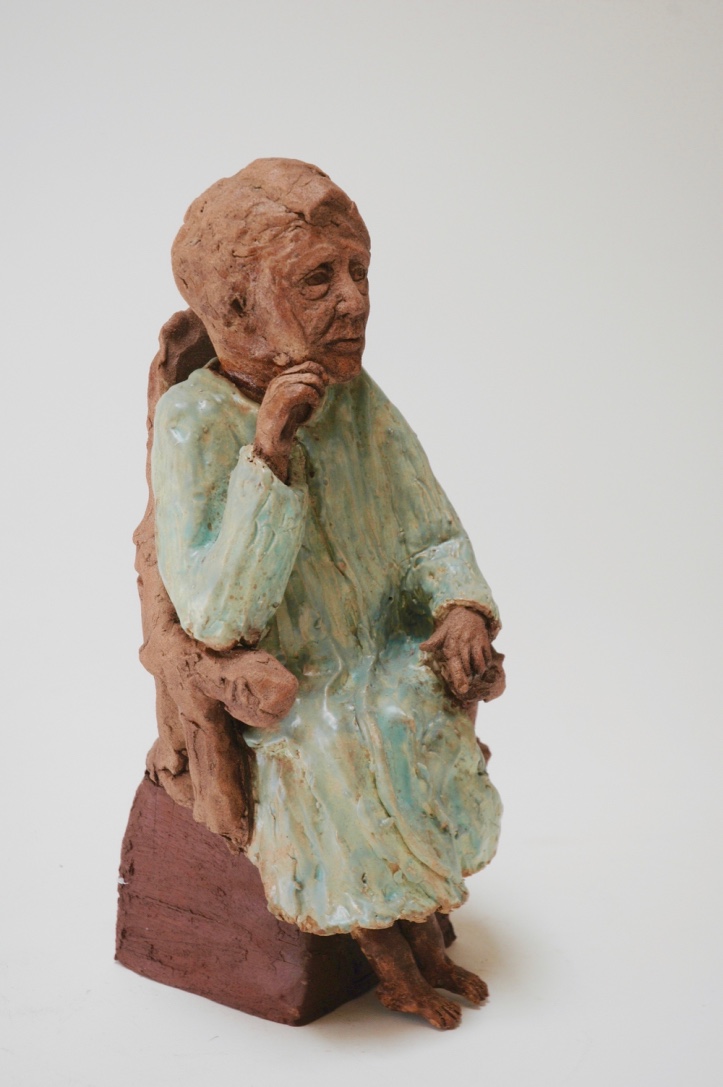
15″ x 7″ x 7″
This peaceful woman in a pale blue-green housecoat, sits musing. Her hand is to her chin and, as with so many of the elderly. Her thinning legs and feet barely touch the floor. She could be anyone’s grandmother.
The inspiration for the sculpture is a painting by Helen Brancato, a Philadelphia artist. The model is an elderly Sister.
While I know little about the Sister, given her age we know she lived through the Depression, two world wars, and the remarkable changes brought about by technology. I think of her as having a secret on how to age well.
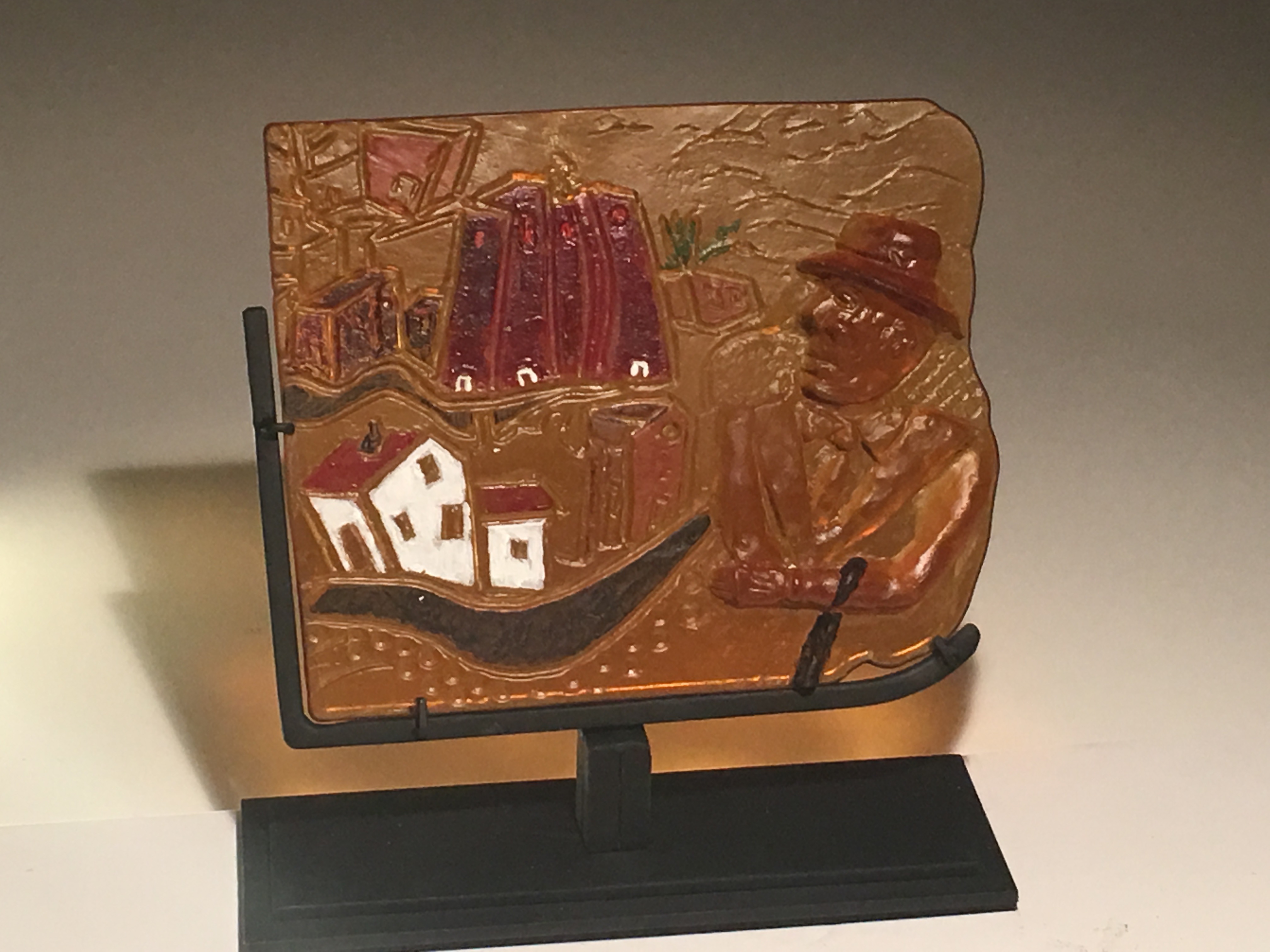
12″ x 12″ x 5″
This old man with a cane over his arm, sits in a chair, and looks down over a distant village. He seems relaxed. His hat adds a note of formality to the setting. The rich amber-red color of the glass hints of autumn. The city is Santa Fe, noticed by its Cathedral, hills, winding roads and architecture. Today, few remember the sentiment that gave rise to the city’s name, “Holy Faith.” This man does. He sits wondering. I like to think of him as grateful.
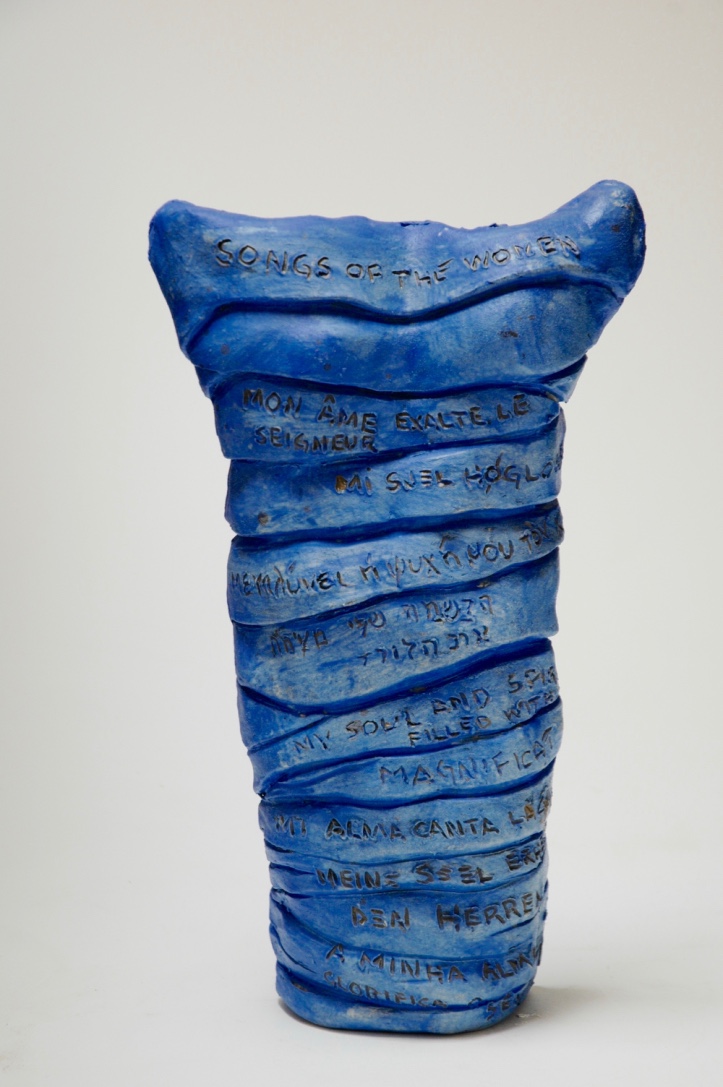
18″ x 11″ x 4″
When Mary greeted the pregnant Elizabeth it is said that the life within her womb moved. Some say leapt. Mary sang what is today known as the Magnificat or the Song on Mary.
I have heard other pregnant women say that they have known what it is like to be greeted by a loved one and to have the life within them to stir.
I’ve carved into clay the opening words of the Magnificat (akin to “I am blessed) in eight different languages.
It is designed as an outdoor hanging.