
Birdhouse Bell
Steel, ceramic, paint
24″ x 7″ x 9″
Birdhouse Bell
Steel, ceramic, paint
24″ x 7″ x 9″

For years, colleagues, friends and family have advised me to slow down. In the workaday world I’ve been encouraged to hurry. I want neither. Rather I want to live reflectively. This sculpture is about pausing … depending on how slowly or frenetically we may live. Said another way it is about having a thoughtfulness about ourselves. I have tried to create a sculpture that invites the passerby to reflect….whatever their 0chosen speed. I do not want to be didactic beyond that paused moment.
PAUSE
Steel, glass, acrylic paint
60” x 24” x 24″


When a loved one dies, words falter. So does life, at least for a moment, sometimes an extended one. This sculpture expresses that wordless many dimensioned experience of faltering. I use design and the medium of steel…usually associated with being cold, heavy and rigid…to express warmth, motion, and hope.
IN MEMORIAM
Steel
18″ x 8″ x 7″
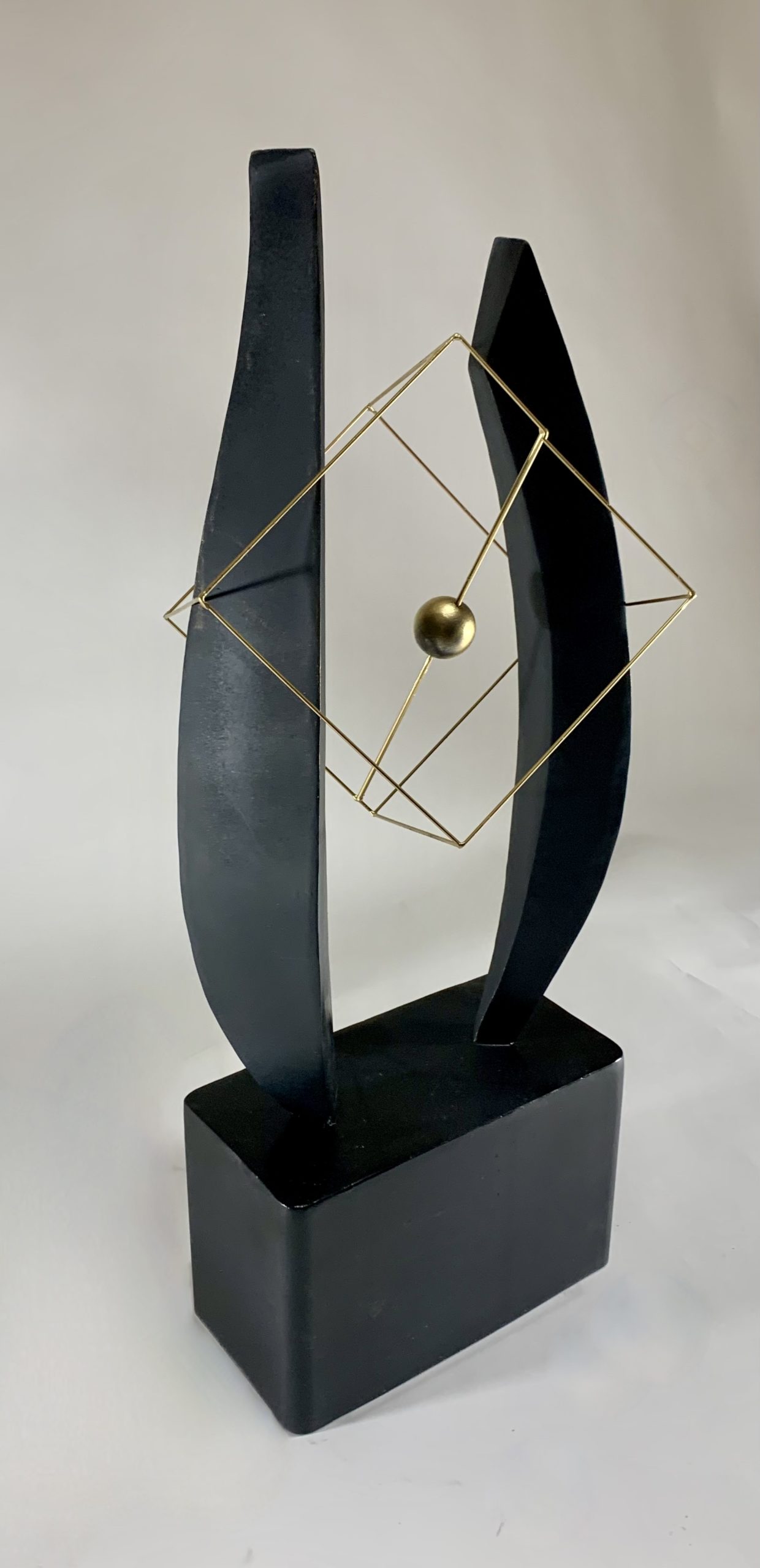
Steel towers, firmly planted, seemingly apart, yet with lingering awareness of dignity and connectedness.
COVID Study
Steel, painted
32” x 12” x 6”
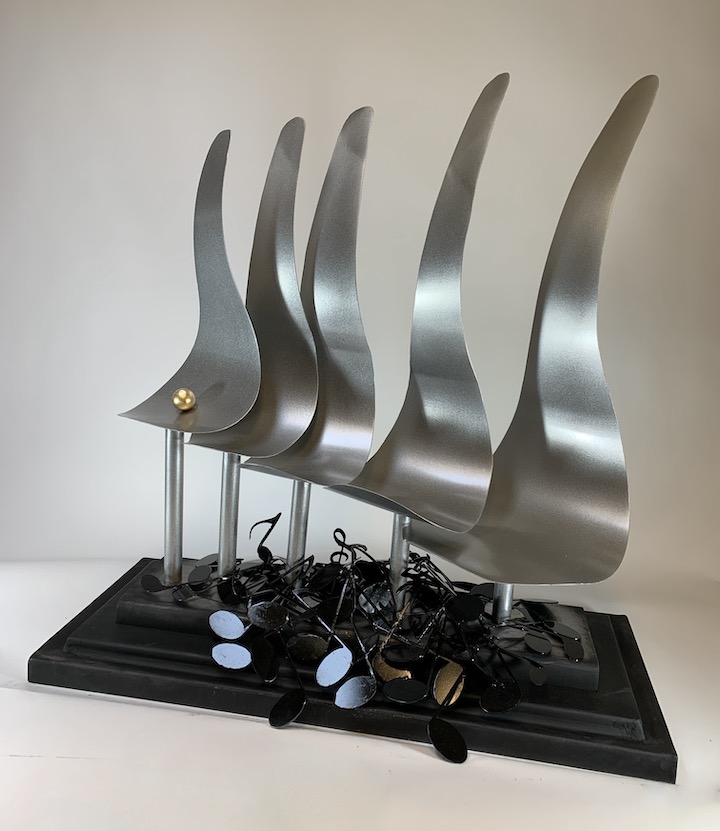
AGING-I
Powder coated steel, paint, gold leaf
30” x 48” x 12”
In this sculpture I use the unyielding medium of steel to express the utterly vulnerable experience of aging.
Musical notes have fallen into a blackened pile… a way of visualizing something has died…in this case something that was valued. Five brightened contemporary forms rise from the jumble. One holds a golden ball. I am mindful of Jung’s thought that the challenge of aging is that we must adapt to inevitable change. “We cannot live the afternoon of life guided by the program of life’s morning.”
I envision this relatively large sculpture resting in an overgrown garden surrounded by foliage both alive and deadened. My hope is that its shimmer may attract the passerby to linger.
Martin Helldorfer
1936 –
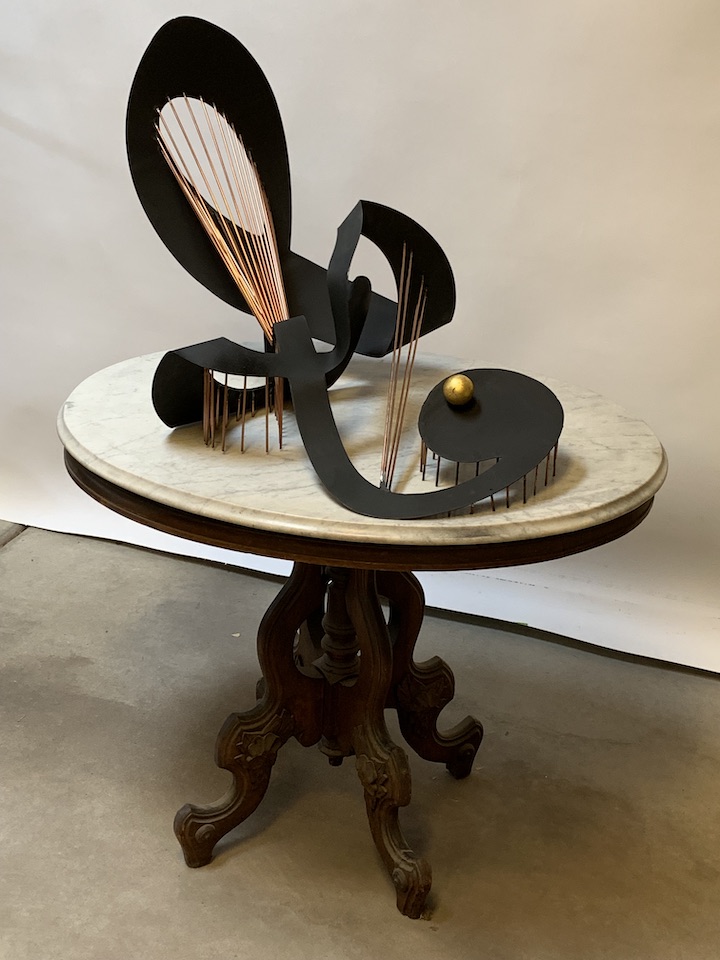
Steel, copper, paint, gold leaf
20” x 25” x 17”
This sculpture began as a musical symbol, a clef, cut from a sheet of 14 gauge steel. My plan was to use it as part of a larger outdoor garden sculpture. I jettisoned that plan. Consequently the clef sat for months unused in the corner of my workshop. After months it found its way to the scrap pile to be sold for pennies on the dollar.
One morning when I felt blah I took the clef from the pile and wondered what it would look like if I crushed it. Without a thought or plan I forced it into the jaws of a large industrial vise. The results were disappointing. It was returned to the scrap pile.
John Boyce (sculptor, department chair) walked by, noticed it, and casually remarked, “I like that. You oughta think of doing something with it.”
I did. This is the result. It is a metaphor. The clef has been crushed yet if you look closely it remains. The piece has a beauty all its own. To return to Jung’s thought, The need to change is never ending. “We cannot live the afternoon of life guided by the program of life’s morning.”
Martin Helldorfer
1936 –
A Clunker
I think of a clunker as something that is old, run down; maybe a lemon. A thing that clunks is a dud; better still, a flop. This bell is a clunker. Strike it hard and you’ll hear the sound of a first class clunk. Nudge it carefully and you will hear music.
The reasons for the harsh dull sound are many. One is that the bell was constructed from a discarded aluminum cylinder. There is not a drop of bell-quality bronze in its make up. Neither does the shape of this bell favor a rich sound. There is simply no space to favor resonance.
I’ve made many rich-toned attractive bells. This is not one of them. Yet it is my favorite. I’ve no idea why.

A Clunker
8″w x 8″d x 20″h
Aluminum, steel, painted
Planter/Aviary
Wikipedia reminds us that planters are often round, earth colored pots, usually fashioned from fired unglazed clay. This is a planter that is not. All (except the flowers) are of steel. The base of the planter has a rusted patina; the birds and swirling wind-like structures are a powder-coated vivid black.

Planter/Aviary
Steel, lower section rusted patina; upper section powder coated black
36″ W x 36″D x 77″H
$650 (flowers not included)
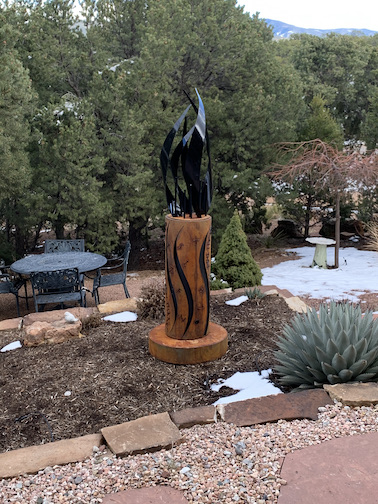
“GRATITUDE”
30″ x 30″ x 78″
Weathered steel, paint, inlaid roofing paper
I am an artist, albeit an aging and aspiring one. With this piece I have tried to express the lingering experience of gratitude that age and loved ones bring. Dag Hammarskjold, the deceased and former Secretary General of the United Nations, penned in words what I have tried to sculpt in steel:
“For what has been, thanks. For what will be, yes.”
What to do?
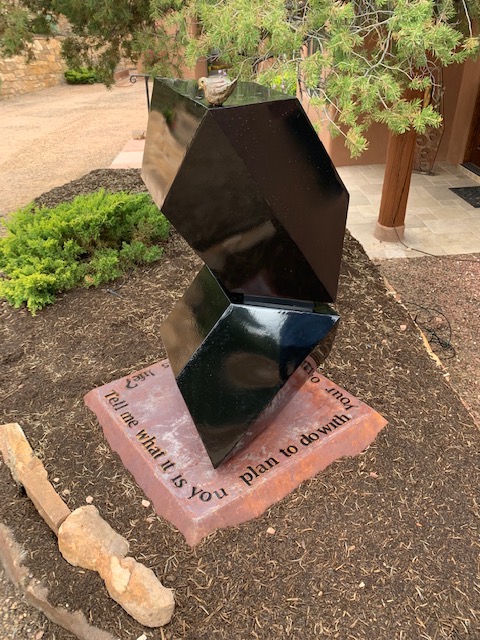
One line penned by the poet Mary Oliver has stayed with me over the years. “Tell me, “ she asks, “what is it you plan to do with your one wild and precious life?” I heard that question at age 17 when I wondered about becoming a monk. It surfaced again when I found myself, after years of study, mismatched to a profession. Then again when pondering marriage. Later still, when about to retire.
Why do I mention such times? To tell you about my self? No. I simply want to thank Mary Oliver for asking the question with which we all struggle, “What is it you plan to do with your one wild and precious life?” Answered once, it will rise again. The sculpture is a reminder.
My hope is that the stark contemporary form of the sculpture will move viewers to take a second look, to notice its small bronze bird, and be drawn to ponder Mary Oliver’s sentiment.
“The Summer Day” by Mary Oliver
I don’t know exactly what a prayer is.
I do know how to pay attention, how to fall down
into the grass, how to kneel down in the grass,
how to be idle and blessed, how to stroll through the fields,
which is what I have been doing all day.
Tell me, what else should I have done?
Doesn’t everything die at last, and too soon?
Tell me, what is it you plan to do?