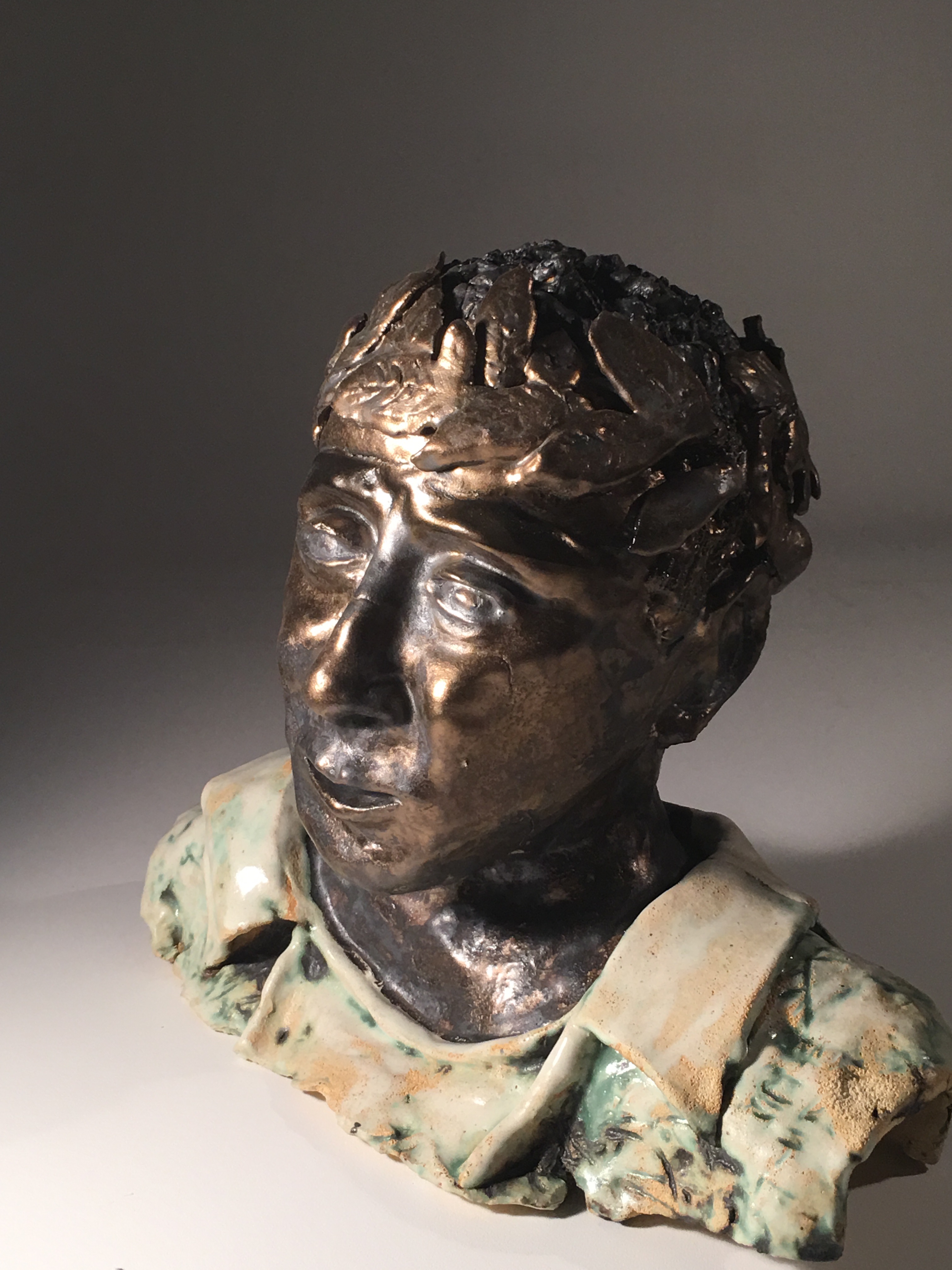
Marcus Aurelius
12″ x 12″ x 8″
While antiquity has left us numerous busts of Marcus Aurelius, I wanted to sculpt another. Why? Because I admire the man. He had an inward life. This is how Professor Joseph Badaracco of the Harvard Business School described the emperor’s way of living.
“Marcus knew full well the areas and responsibilities of practical life. He ruled a vast, diverse, unruly empire that spanned much of Europe, North Africa, and the Middle East. Marcus was…the chief priest of the Roman religion, and the highest judge in the Roman courts…. How did Marcus Aurelius combine the life of action with the spirit of reflection? How did he take the long view of the urgent tasks of the present moment? The answers lie in his personal journal. During the last years of his life, Marcus kept an informal record of his reflections, observations, and self-criticisms. He wrote for himself, not for the eyes of others. He wanted to understand who he was and how he should work and live. Marcus called the journal “To Himself,” and only centuries later did it come to be called “Meditations.” (available free on Kindle, my note)
….
“The first lesson Marcus Aurelius might suggest for managers has nothing to do with work. In fact, its focus is on “not” working. Marcus’s advice would be to work hard to create moments of serenity. Again and again, throughout Meditations, Marcus reminds himself to slow down and step back, to withdraw and reflect. He writes, “Are you distracted by outward cares? Then allow yourself a space of quiet, wherein you can add to your knowledge of the Good and learn to curb your restlessness.” He tells himself, “Nowhere can a man find a quieter or more untroubled retreat than in his own soul.” And again, “Avail yourself often, then, of this retirement, and so continually renew yourself.”
…
“This talk of retirement and retreat may sound otherworldly and monkish. It may suggest someone without the stomach for the hard work of trying to make a practical difference in the world. But there is no indication that Marcus ever shirked the duties and cares of his position. He ruled until his death—and may actually have hastened it—because he refused, to the very end, to lay down any of the duties and burdens of his office.”
….
“Were Marcus Aurelius alive today, he might well ask managers whether they have, somewhere in their lives, a counterpart to his tent, with its candle and plain table. He would be inquiring (discreetly and quietly—for he was, by all accounts, a gentle soul) not about a physical location, but about a mental retreat where they could reflect and renew themselves. Marcus might well be astonished and concerned at how infrequently the men and women who shoulder so many of the world’s responsibilities remove themselves from other people, agendas, deadlines, telephones, and computers, and simply sit for a while and examine themselves, their lives, their thoughts and feelings.”
Joseph Badaracco, Defining Moments, pp 122, 123.